Never miss a post.
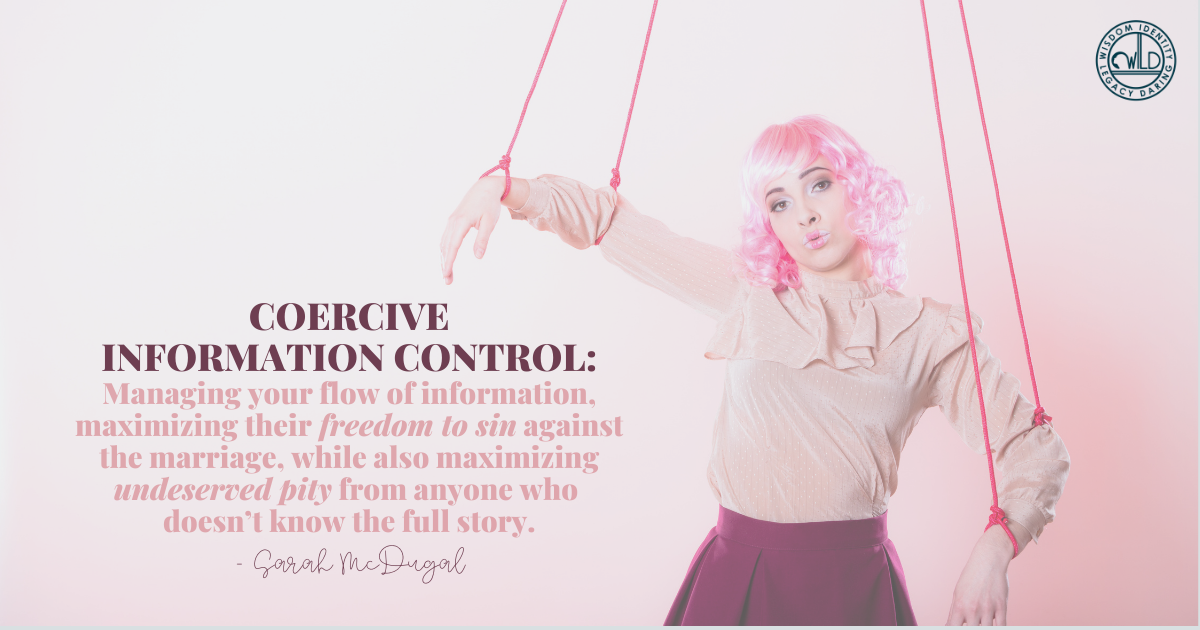
Are You Living with Coercive Information Control?
- Sarah McDugal
- Abuse + Domestic Violence
Most victims don't realize you're living with it...
Once you do realize something is very wrong, you don’t know it’s called coercive control.
Often we think of coercion as someone forcefully controlling what you can or can’t wear, or eat, or do. Or who you are and are not allowed to spend time with. Or whether you have access to essentials like transportation, phone, money, entertainment, a social circle, church involvement, time with family, etc.
What we commonly overlook, however, is how an abuser often micromanages your flow of information.
You see, if someone makes sure you don’t have enough information to put the pieces together, they can keep you in the dark.
In doing so, the abuser maximizes their freedom to sin against your relationship -- by limiting your access to the valuable information required in order for you to make well-informed decisions. When your information is being controlled like this -- you don't have enough data to be able to tell whether they’re lying to you, whether they’re being faithful to you, whether you’re living in safety. This type of control is coercive. It is a form of domestic violence.
It is abuse.
Trying to picture how that might look in real life?
Imagine this:
-
They ask questions, you give honest and detailed answers.
You ask questions, they shrug.
-
They know most everything about you.
You know little to nothing about them.
In the early season of a relationship or social interaction, you may not notice this pattern right away.
Often, that's because it's so flattering to feel that someone is focused on you. They want to know so much about you. They’re asking you questions and really tuning in. They’re listening to everything you have to say. They’re paying attention to you and it feels good.
But an abusive person isn't doing that because they deeply care. Instead, they’re storing up information about you which they can manipulate and weaponize later.
This type of coercive control isn't limited to romantic relationships. It pops up in workplace teams, social groups, girlfriend circles, sibling dynamics... anywhere a toxic person might want to gain control and cause chaos.
Have you ever known someone who asked you a ton of questions, made you feel focused on, listened to, truly seen and heard? They drew out your confidence, plumbed the depths of your trust, and then later -- maybe a week, maybe a month, maybe two years later -- they remember exactly what you shared.
Then, they use that knowledge at precisely the right time and in the right way to cause you the greatest amount of pain in repayment for your vulnerability. They can do this because they have studied you and they know how to use that information against you.
(Read my eye-opening journey through a volatile work situation where information control was a significant factor, in the first chapter of my book One Face: Shed the Mask, Own Your Values, and Lead Wisely.)
It's common for toxic personalities to gain power in relationships by learning details about everyone else, while revealing very little about themselves. When you try to discover more about them, they answer with platitudes, shrugs, or just pat answers that actually tell you nothing.

They don’t share their stories.
They use words without giving actual facts.
They don’t detail specific events, but default to broad generalities.
They're the master of vague non-answers.
Or, they act too tired, bored, or over it to really engage.
Somehow, they find a way to dodge every time you have an important or necessary question.
People who do this are creating a relationship dynamic where they have maximum freedom. And they garner maximum pity.
Consider this hypothetical situation:
Let’s say you're in a marriage where your husband is committed to secretly cheating on you, and/or he has an addiction that he doesn’t want you to discover. So he says he's been needed more at work lately, and tells you he can't help the long extra hours.
He’s gone so much. You miss him. You start to wonder if his long hours are worth the financial tradeoff.
So you try to be supportive...
You: Hey, I could work some. Maybe I get a part-time job so we both contribute to the family budget, and you wouldn’t have to work so much. You could be home with our family more and maybe get some rest.
Him: No, no, I don’t want to make you do that. I don't want to put that burden on you. I’ll keep working.
And so he stays gone... even more than before.
You feel so bad for him. He's working so hard.
He's making such sacrifices for your family, for your finances.
You pity his exhausting late nights and rushed early morning departures and the increasing work trips.
Maybe you've also accumulated some credit card debt. He uses fiscal responsibility to justify his absences: “I have to work so much because we have all this debt. I have to pay off these credit cards. You spent too much, so now I have to work all the time.”
But you know you're frugal. You know you try to carefully meet the budget. You're not sure how the credit cards got so high, but he's so tired you don't want to push for answers. And whenever you want to do something together, he’s too tired. He’s not energetic enough to be interested.
So you feel guilty inside. Especially when he blames his long hours on how you make him have to work so hard.
It’s because of you that he’s gone working all the time, he keeps saying. And he’s bitter and resentful and angry. And then you feel awful for asking to do anything with him, because you feel like you're a burden.
So you stop asking him to do things.
You stop asking him to be present with you and the children.
You stop asking questions.
What you don't know, in this hypothetical story, is that his long hours were never spent at work at all.
He's got a girlfriend.
Or, he’s got a gambling addiction.
Or, he’s got a pornography addiction.
Or, he's just escaping to spend time doing his own thing.
Or some other secret he’s keeping.
Here's what else you don't know... At work, he’s talking smack about how his wife spends all his money and won’t help with the bills. He's telling his teammates that his wife sits around at home and refuses to get a job. He complains to his girlfriend that his wife is a miserable controlling shrew and won't let him do anything fun.
In doing so, he garners maximum pity from others, while also creating maximum freedom for himself, because you thinks he’s working all those extra hours to pay your bills.
What you don't know (because you don't have access to all the bank accounts and credit cards), is that your family debts are primarily incurred by his pleasures, whether it's his girlfriend, his expensive hobbies, his addictions, or something else.

You may not yet know there’s even a problem.
Because when he comes home exhausted, you believe it’s because he’s been working so many hours for your family's provision. And when you ask about his work, he implies it’s unavoidable because you and the kids cost so much.
Your conscientious guilt is an effective silencer.
You're innocently trusting, because you don't have all the information. And he claims the sympathetic ear of anyone looking in from the outside, who doesn’t know the full story.
Could these roles be reversed, where a wife is keeping information from the husband? Absolutely.
Could it happen in a workplace where someone is manipulating your flow of information to maximize their freedom and gain, while you're just keeping your head down and trying to do a good job, and you have no clue you're being screwed over? Absolutely.
Coercive Information Control is not an exclusively gendered male-perpetrator scenario, although it is extremely common in domestic violence situations.
You have a right to complete information.
You have a right to know the truth. You have the right to make informed decisions that are best and safest for you, your children, your home, and your future.
If you are in a dynamic like this, you have a right -- as an adult partner -- to know what is going on:
To know where your spouse is spending their time.
To know what is happening with the finances.
To know what is happening with the debt.
To know what is happening at work.
If you are being intentionally, subtly, quietly, or even overtly shut out of those things, and you realize something is not right; then it is possible that you are experiencing coercive control over your flow of information.
If this is what you’re living with, it's very likely that you're experiencing other forms of domestic violence and betrayal, as well.
And you absolutely have the right to know what is true.

Go-to support hub for women who are ready to thrive after surviving abuse or betrayal —
with super affordable, trauma-sensitive group coaching + community.
Support Group>>WILD TraumaMamas: Because Momming After Trauma isn't for the Faint of Heart
Follow on Facebook and Instagram.
Subscribe on YouTube for hundreds of free videos on abuse recovery.

Browse my Best Books List to find safe resources on betrayal trauma, healing, relationships, and more!
Want more articles like this?
Get new posts straight to your inbox!